
Formal finance withdraws
Banks, donors and investors pull back when value flows cannot be verified.
Trust as a Service
Payvand records every step of a transfer, from the sender’s instruction to cash payout and recipient verification, so donors, organizations and institutions can work in fragile and frontier markets with audit-ready data, without replacing the hawala networks communities rely on.
The challenge
Informal value transfer systems such as hawala are critical infrastructure where formal finance cannot operate. But when value flows cannot be verified, a self-reinforcing cycle begins.
Banks, donors and investors pull back when value flows cannot be verified.
Out of necessity, economic activity moves to networks that institutions cannot see into.
Greater reliance on opaque systems deters institutional re-entry, and the cycle continues.
Payvand is built to break this loop: verifiable records that bring institutions back, while local networks keep their agency.
How hawala works
In traditional hawala, a sender, two trusted sarafs and a recipient coordinate through phone calls, messages and paper ledgers. Payvand keeps those same trusted relationships and adds one shared record for every step.
Solutions
Services for individuals and organizations, from everyday transfers to salary payments.
Send and receive money through a digital wallet.
Learn moreFollow a transfer from initiation through saraf reviews, payout and recipient verification.
Learn morePayment solutions for organizations and their employees.
Learn moreMobile credit and minutes as part of Payvand’s services.
Learn moreThe platform
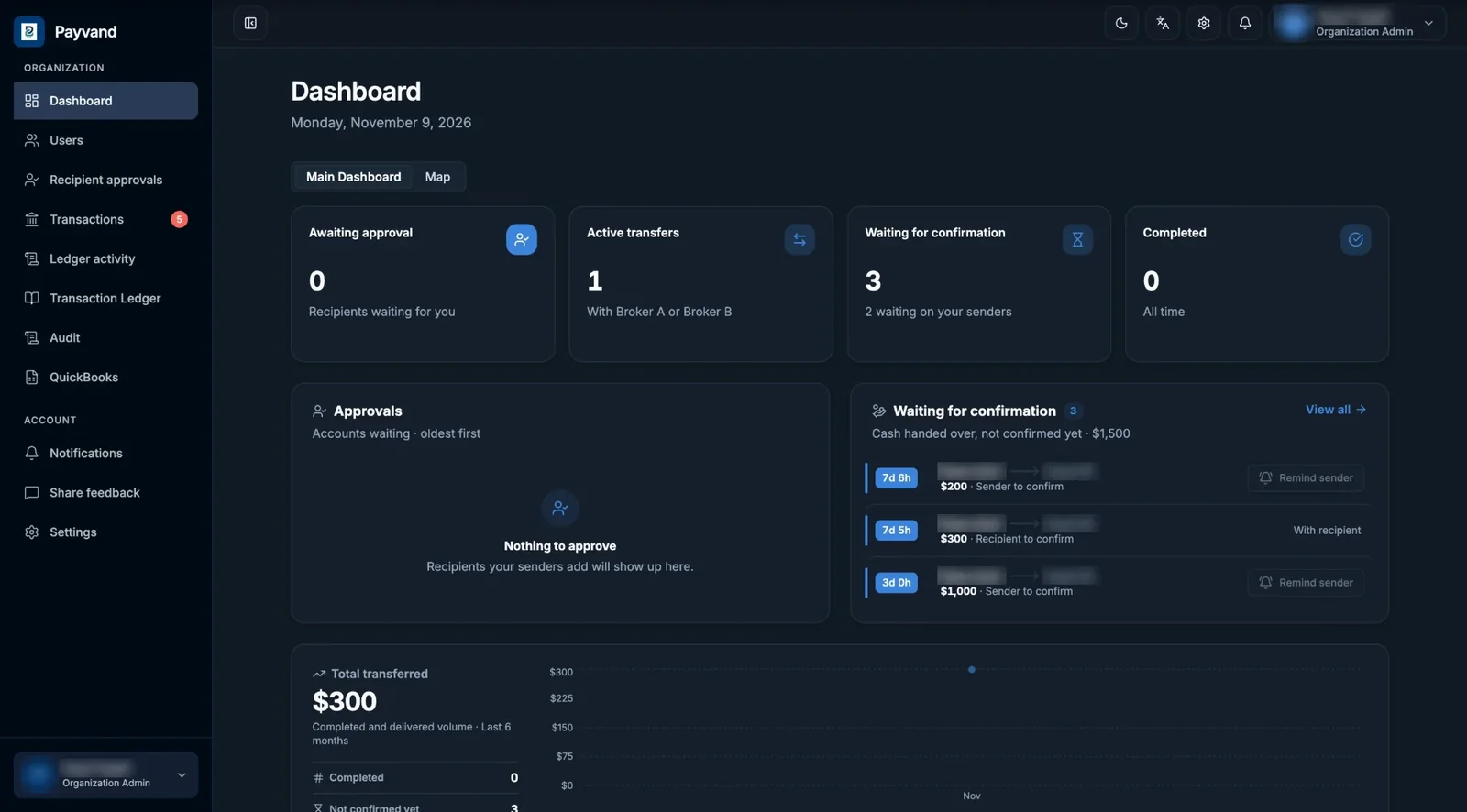
Organization administrators see what needs attention: recipients awaiting approval, transfers in progress with each saraf, and cash handed over but not yet confirmed.
Hawala tracking
From the coordinator’s instruction to payout, verification and recipient feedback.
The coordinator registers the recipient, starts the transaction and selects Broker A.
Broker A reviews the transaction and, if approved, forwards it to Broker B for a second review.
Once Broker B approves, the recipient receives an SMS with a code and the amount. Broker B checks these and the recipient’s ID before payout.
After payout, the recipient completes identity verification and feedback. Cases that need review go to an administrator.
Visibility & accountability
Transaction events, defined responsibilities and recipient verification support oversight.
Applicants are screened against sanctions lists during registration.
Coordinators, sarafs and administrators each have defined responsibilities.
Identity checks and recipient feedback document who received the payment and the amount reported.
A digital twin captures payment events as cryptographic receipts on a blockchain-backed ledger.
Beyond transfers
The same verified records power tools for compliance teams and programs operating in austere settings.
Network-level analysis that helps distinguish illicit activity from legitimate cultural and family remittances.
Learn moreEnd-to-end visibility for medical shipments, equipment and other goods in austere settings.
Learn moreDelivery and payment events captured as cryptographic receipts, creating ground-truth data.
Learn moreWho we serve
Verify that aid reaches the intended recipient, with audit-ready data.
Re-engage in high-risk regions with accountability built in.
Manage users, roles, transfers and salary payments in your own environment.
Keep your trusted relationships and add a verifiable record to every transfer.
Are you an organization, a saraf or a potential partner? Request a demo or talk to our team about your requirements.